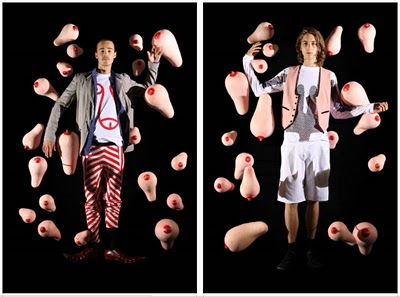
Robin van den Akker & Timotheus Vermeulen
Monday, 15 November 2010
Einheitsdenken nach der postmoderne
Robin van den Akker & Timotheus Vermeulen
Tuesday, 26 October 2010
Domestic politics in metamodern times
Thursday, 14 October 2010
What meta means and does not mean
Over the last few months, there has been much discussion online as well as at parties, galleries and conferences, about the meaning of the prefix meta- in metamodernism. Now, of course, each and everyone is free to define, re-appropriate and use it in any one fashion. Metamodernism as a term - but not as a concept - is or has been associated with altermodernism, reflective modernism, reflexive modernism, and a counterstrategy within modernism. And it has been applied to developments and disciplines as diverse as economics, politics, architecture, data analysis, and the arts. But (or So) we feel compelled to once more establish what WE mean with the prefix meta - and, perhaps even more important, what we do not intend by it. In a previous post we described it as follows:
The prefix 'meta' has acquired something of a bad rep over the last few years. It has come to be understood primarily in terms of self-reflection - i.e. a text about a text, a picture about a picture, etc. But 'meta' originally intends something rather more colloquial. According to the Greek-English Lexicon the preposition and prefix ‘meta’(μετά) has several meanings and connotations. Most commonly it translates as 'after'. But it can also be used to denote qualitative 'changes' or to designate positions such as 'with' and 'between'. In Plato's Symposium, for example, the term metaxy designates an ontological betweenness (we will return to this in more detail in a later post). The Online Etymology Dictionary gives the following description:
prefix meaning 1. "after, behind," 2. "changed, altered," 3. "higher, beyond," from Gk. meta (prep.) "in the midst of, in common with, by means of, in pursuit or quest of," from PIE *me- "in the middle" (cf. Goth.miþ, O.E. mið "with, together with, among;" see mid). Notion of "changing places with" probably led to senses "change of place, order, or nature,"
When we use the term 'meta', we use it in similar yet not indiscriminate fashion. For the prefix 'meta-' allows us to situate metamodernism historically beyond; epistemologically with; and ontologically between the modern and the postmodern. It indicates a dynamic or movement between as well as a movement beyond. More generally, however, it points towards a changing cultural sensibility - or cultural metamorphosis, if you will - within western societies.Thus, although meta has come to be associated with a particular reflective stance, a repeated rumination about what we are doing, why we are doing it and how we are doing it, it once intimated the movement with and between what we are doing and what we might be doing and what we might have been doing. When we use the prefix meta- we do NOT refer to the former meaning. Meta- for us, does NOT refer solely to reflectivity, although, inevitably, it does (and, since it passes through and surpasses the postmodern, cannot but) invoke it.
When we use the prefix meta- we refer to the latter intent. Meta, for us, signifies an oscillation, a swinging or swaying with and between future, present and past, here and there and somewhere; with and between ideals, mindsets, and positions. It is influenced by estimations of the past, imbued by experiences of the present, yet also inspired by expectations of the future. It takes into account and affect the here, but also the there, and what might or might not happen elsewhere. It is convinced it believes in one system or structure or sensibility, but also cannot persuade itself not to believe in its opposite. Indeed, if anything, meta intimates a constant repositioning. It repositions itself with and between neoliberalism and, well, keynesianism, the "right" and the "left", idealism and "pragmatism", the discursive and the material, the visible and the sayable. It repositions itself among and in the deconstructed isms and desolate ruins that rest from the postmodern and the modern, and reconstructs them in spite of their un-reconstructableness in order to create another modernity: then one, then the other, one again, and yet another. Bas Jan Ader's quest for the miraculous, Charles Avery's quest for an imaginative elsewhere, Mona Hatoum's search for another socio-personal identity, Sejla Kameric longing for another ethnic-personal epistemology, Mariechen Danz's longing for the pre-discursive, Ragnar Kjartansson's desire for what is always just beyond his reach…
Meta- does not refer to one particular system of thought or specific structure of feeling. It infers a plurality of them, and repositions itself with and between them. It is many, but also one. Encompassing, yet fragmented. Now, yet then. Here, but also there.
Wednesday, 13 October 2010
Russel Brand from mannerism to metamodernism?
Thursday, 23 September 2010
Hard boiled wonderland - from pomo to metamo
It has become somewhat of an axiom to associate certain artistic practices to specific discourses, and specific artists to certain sensibilities. It has become a truism, for instance, to link practices as diverse as eclecticism, parody, pastiche, detachment, flexi-narrative, and parataxis to the postmodern, and strategies like ‘optimism’, self-consciousness, formalism, functionalism, purism, and streams of consciousness to modernism. It has become as much of a platitude to call artists as different as David Lynch, David Fincher, Jeff Koons, Gregory Crewdson, Bret Easton Ellis and Haruki Murakami postmodern, as that it is a cliché to assume that Fritz Lang, Sergei Eisenstein, Pablo Picasso, Piet Mondriaan, Marinetti, Ezra Pound and Virginia Woolf are modernists.
It is easy to criticize such assumptions. Too easy. For we all need to order and schematize practices and discourses, artists and sensibilities, so that we can appreciate what any one particular stylistic choice or artist’s feature might intend or mean. Indeed, if this blog does anything at all, it is ordering and schematizing otherwise incoherent trends and tendencies by tying them to this sensibility we have come to call metamodernism.
We need to from time to time revise these clichés. Rearrange practices, reshuffle sensibilities. It is by occasionally readjusting what belongs here and who goes there that we keep the commonplaces up to date. It is by readjusting that our everyday definition of a discourse retains its aptitude for the next generation, our appreciation of an artist its value for the generation after that.
In what follows, I will do just this. Rearrange and reshuffle.
Thursday, 16 September 2010
Galerie Tanja Wagner opens its doors - onto the metamodern
On the 25th of September, Galerie Tanja Wagner will open its doors with the much anticipated, aptly titled exhibition 'Die Tur geht nach Innen auf'. But what is it that we encounter inside?
"Galerie Tanja Wagner inaugurates its space on September 25 at Pohlstraße 64, Berlin-Schöneberg with the group exhibition Die Tür geht nach Innen auf (The Door Opens Up Inwards).
Doors can prohibit the passage from one room to the other, but they can also facilitate it. Most of them do both. Doors negotiate between a somewhere and an elsewhere; the outside and the inside; between one room and the next.
The exhibition Die Tür geht nach Innen auf presents works by Mariechen Danz, Paula Doepfner, Šejla Kamerić [see also our earlier post, ed.], Issa Sant and Angelika J. Trojnarski. Even though the artists engange with different subjects and materials, they each seek to create a tension between two situations, indeed, between two spaces. All works negotiate between the sayable and the visible: between what can be said and what can be shown, representation and presence. However the first impulse is always set by the art work.
The works convey enthusiasm as well as irony. They play with hope and melancholy, oscilliate between knowledge and naivety, empathy and apathy, wholeness and fragmentation, purity and ambiguity, while looking for a truth without expecting to find it; which corresponds to what Timotheus Vermeulen and Robin van den Akker have termed metamodernism."
Wednesday, 8 September 2010
The New Weird Generation (part 1)
I think this is a more wake period in culture. That was a horrible period. You know, the early nineties, you had like Kurt Cobain. The only thing that could manage to break through that wall was this scream of depression and rage that was Kurt Cobain. But other than that, what was there? Things sort of radically diversified after the new millennium. […] Suddenly, there was this frolicking group of outrageously colourful young people with their eyes wide open. But not like naïve, but almost emerging from a basic need to survive and to live… […] There was something very primary and very beautiful about what they were doing, and creating spaces that had the potential for hope to exist in them. […] It’s not cynical, that’s the thing.
So, what is New Weird America?
Sunday, 5 September 2010
The Fountain - A call to discussion

Monday, 30 August 2010
Henrik Vibskov
Monday, 23 August 2010
The rise of the BRICs
"We are countries where everything happens on a large scale. We represent nearly one half of the world population, 20 per cent of its land surface and are rich in natural resources. Today, the BRICs have become essential players in major international decision-making. As such we are acutely aware of our potential as agents of change in making global governance both more transparent and democratic. This is the message Brazil offered at the second BRIC Summit, held here in Brasilia, where the leaders of Brazil, Russia, India and China gathered on April 15. [...] We are committed to building a joint diplomatic and creative approach with our BRIC partners in order to tackle...global challenges."How to describe this emerging landscape of power? As multi-polar? Perhaps. As multicentric? Maybe. One thing is sure, though. In the coming decades, the so-called West needs to come to terms with the economic and political rise of the BRICs. One way or another.
Thursday, 19 August 2010
The New Museum goes metamodern?

The New Museum goes metamodern?
Eu desejo o seu desejo / I Wish Your Wish (2003) is installed in the lobby gallery as part of the exhibition "Rivane Neuenschwander: A Day Like Any Other". Visitors are invited to select ribbons printed with a wish to tie around their wrists. When the ribbon falls off, tradition has it that one's wish will be fulfilled. Visitors may write another wish and place it in the empty hole. This work of art is based on a similar practice that takes place at the church of Nosso Senhor do Bonfim (Our Lord of the Good End) in Salvador, Bahia, Brazil.
Friday, 13 August 2010
Quirky

Quirky is a sensibility that can be recognised most easily by its tone, which we might broadly describe as walking a tightrope between a cynically ‘detached’ irony and an emotionally ‘engaged’ sincerity. This tone is created in a number of ways.
Thursday, 12 August 2010
Selja Kameric (1)
It is difficult to describe what Selja Kameric’s work is about. It is about an international conflict (the Balkan wars). It is about the decline of a city (Sarajevo). It is about ethnic cleansing (of Bosnian-Herzegovians). It is about longing for a past that is lost (a culture's, a city's, the artist's). It is about the emancipation of a young girl (the artist herself). Kameric's work is political. But it is also personal. However, one would be mistaken to call the political personal and vice-versa.
One might be tempted to argue it is about deconstruction. Works such as EU/Others (2000) and Bosnian Girl (2003), which examine the relationship between representation and subjectivity, would certainly vindicate such an assertion. But then one might also suggest it is about reconstruction. The piece Dream House (2002), for instance, situates a refugee camp within parameters that place it beyond its conventional confines. The camp’s spacetime transits from sunset into sunrise, transforms from desolate desert to desirable beach. The work thus constructs the impossible possibility of an elsewhere beyond the now-here.
Similarly, one may feel Kameric’s work is concerned with the past. After all, many of her works address traumas and memories. Yet one cannot but feel it is equally preoccupied with the future. In Red (2008) Kameric seeks to trace what is lost. She traces marks on red brick walls left by explosive devices. In Green (2007) she tries to find expressions of what cannot be expressed. She photographs names carved in
Monday, 9 August 2010
New Romanticism
The world must be romanticized. In this way its original meaning will be rediscovered. To romanticize is nothing but a qualitative heightening. In this process the lower self becomes identified with a better self. (...) Insofar as I present the commonplace with significance, the ordinary with mystery, the familiar with the seemliness of the unfamiliar and the finite with the semblance of the infinite, I romanticize it. Novalis
Sunday, 8 August 2010
Rodarte
Fashion is mostly an endless repetition of something you already have seen before. Season after season trends are recycled to awaken a new desire within the consumer, making fashion the ultimate post-modern expression. But every now and then someone tries to escape this endless cycle of repetitiveness. Kate and Laura Mulleavy of Rodarte have tried to do so ever since they presented their first collection in the spring of 2005 in New York. In their parent’s garden house in Pasadena, California, the self-taught Mulleavy sisters first started creating dresses for their Barbie dolls, and even though Rodarte is now one of the most anticipated shows of the New York fashion week, Kate and Laura Mulleavy never really escaped that doll-like dream world. Their intricately and obsessively handcrafted designs show an otherworldly desire. Even though the Rodarte girl – she is always a girl, never a woman - is more than equipped to deal with reality in her spiked and studded heels, her camouflage body art and her tribal dresses, she above all projects a childlike naivety. A naivety that is corrupted and innocent at once, whether it is the Japanese horror goth from their Fall/Winter 2008 collection, the post apocalyptic warrior negotiating between culture and nature from their Spring/Summer 2010 collection or the ethereal Mexican sleepwalkers from the troubled border town of Ciudad Juárez represented in their Fall/Winter 2010 collection.Thursday, 5 August 2010
Herzog & de Meuron (1)
Sunday, 1 August 2010
Strategies of the metamodern
Wednesday, 28 July 2010
Glory At Sea
“I’m always asking my dad how that boat knew to go down right there, right over us. He laughs and says, ‘God did it.’"
I take Glory at Sea to be metamodern simply in the sense that it embodies one of the discourse’s many strands: a contemporary form of Romantic Irony – what Schlegel called “the eternal oscillation between enthusiasm and irony”. This is a feature that we can see reappearing in different forms in a significant number of recent movies, and one which I shall be returning to on this blog.
Tuesday, 27 July 2010
Best Coast
The first time I heard Best Coast I was green with envy. This was the music I had wanted to make when I was sixteen. At that time I was listening a lot to Bikini Kill, Hole and Sleater-Kinney. I never managed to pick up a guitar and now I see why: I was afraid to turn sour, cynical and frustrated, just as the girls from these bands were. Though it might be easy to file away Bethany Cosentino with screamers like Courtney Love and Kathleen Hanna, she’s got much more to offer than that. Along with bands like Vivian Girls, Dum Dum Girls and Frankie Rose & The Outs, Best Coast offers a disarming naiveté and sincerity that has been long lost in popmusic. The scuzzy lo-fi production, the echoing drums and overdose of reverb may hide that at first, but when you hear Cosentino sing The other girl is not like me she's prettier and skinnier / She has a college degree, I dropped out when I was seventeen / If only I could get her out of the picture / Then he would know how much I want him in the song Boyfriend without a hint of irony you cannot help but empathize. Where sixties girl groups like The Ronettes sang pleadingly about boys full of giddy hope, Beth Cosentino knows she won’t get what she wants, but either way still tries. And you’ve got to admire her for that.Monday, 26 July 2010
Etymology of the term metamodernism

The prefix 'meta' has acquired something of a bad rep over the last few years. It has come to be understood primarily in terms of self-reflection - i.e. a text about a text, a picture about a picture, etc. But 'meta' originally intends something rather more colloquial. According to the Greek-English Lexicon the preposition and prefix ‘meta’ (μετά) has several meanings and connotations. Most commonly it translates as 'after'. But it can also be used to denote qualitative 'changes' or to designate positions such as 'with' and 'between'. In Plato's Symposium, for example, the term metaxy designates an ontological betweenness (we will return to this in more detail in a later post). The Online Etymology Dictionary gives the following description:
prefix meaning 1. "after, behind," 2. "changed, altered," 3. "higher, beyond," from Gk. meta (prep.) "in the midst of, in common with, by means of, in pursuit or quest of," from PIE *me- "in the middle" (cf. Goth. miþ, O.E. mið "with, together with, among;" see mid). Notion of "changing places with" probably led to senses "change of place, order, or nature,"
Image: Gregory Crewdson, Untitled (2006). Courtesy White Cube.